

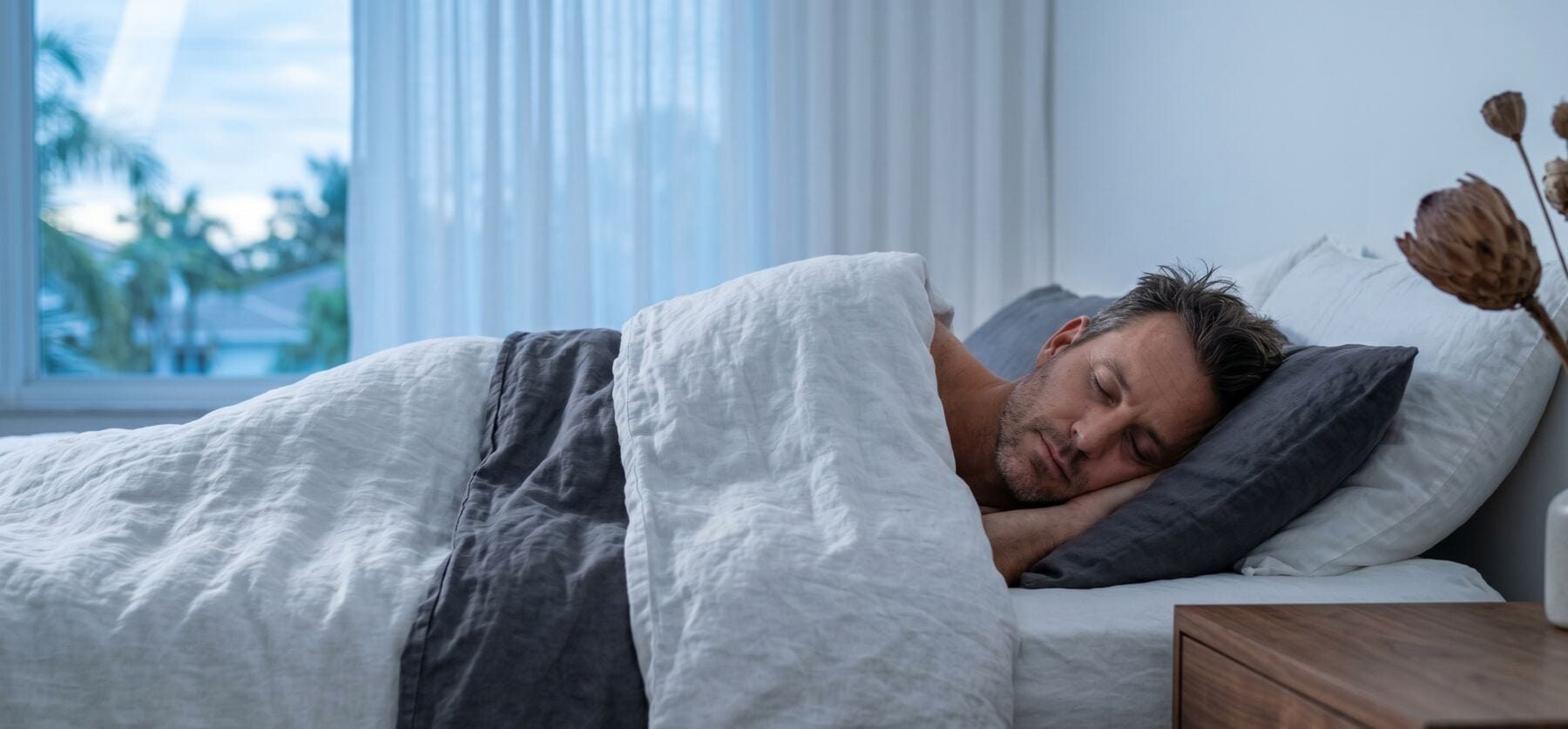
Sleep Optimization for Men: The Complete Guide to Better Rest, Energy, and Hormones
Medically reviewed by our clinical team | Last reviewed: April 22, 2026
This guide is for educational purposes only and is not a substitute for personalized medical advice. If you suspect you have a sleep disorder, please consult a qualified clinician.
If you are a man over 30 who is tired, gaining weight you cannot shake, struggling with focus, or watching your testosterone slide — before you do anything else, look at your sleep. Sleep is not a lifestyle accessory. It is the single most powerful recovery, hormonal, and metabolic intervention available to you, and most men are getting it badly wrong.
This guide walks through what sleep actually does for male physiology, why it degrades with age, how to recognize the disorders men most commonly miss (especially sleep apnea), and what a real sleep optimization plan looks like.
Why sleep matters more than you think
Sleep is not “off” time. It is when your body does its most important hormonal, neurological, and cellular work. A single night of short or fragmented sleep measurably:
- Reduces testosterone — studies show roughly a 10–15 percent drop after one week of 5-hour nights
- Raises cortisol, promoting abdominal fat storage
- Worsens insulin sensitivity, pushing you toward pre-diabetic territory
- Increases hunger hormones (ghrelin) and reduces satiety hormones (leptin)
- Impairs reaction time and cognitive function comparable to legal alcohol intoxication
- Weakens immune function
- Increases systemic inflammation
- Reduces libido and erectile function
Chronic short sleep (under 6 hours) compounds these effects and is independently associated with higher rates of cardiovascular disease, type 2 diabetes, depression, dementia, and all-cause mortality. This is not a question of feeling tired — it is a question of how long you live and how well.
How much sleep do men actually need?
The honest answer: most adult men need 7 to 9 hours of quality sleep per night. A small percentage of people genuinely function on less — but research suggests that most men who think they are in that group are not. They have simply adapted to chronic sleep deprivation and normalized feeling worse than they should.
Quality matters as much as quantity. Eight hours of fragmented, apnea-interrupted sleep is not equivalent to eight hours of continuous, deep, well-staged sleep. Which brings us to the most important hidden issue.
Sleep apnea: the disorder most men miss
Obstructive sleep apnea (OSA) is far more common in men than women, and dramatically underdiagnosed. Estimates suggest that 20 to 30 percent of middle-aged men have at least mild OSA, and the majority do not know it.
In OSA, the airway collapses repeatedly during sleep, causing brief drops in oxygen and micro-awakenings the brain does not consciously register. You may think you are sleeping 8 hours, but your body is being pulled out of restorative sleep dozens or hundreds of times per night.
Signs to pay attention to
- Loud snoring (especially if a partner has mentioned it)
- Witnessed pauses in breathing
- Gasping or choking awakenings
- Waking up tired even after a “full night”
- Morning headaches
- Daytime sleepiness or falling asleep easily during quiet moments
- Mood changes, irritability, reduced focus
- Unexplained weight gain or inability to lose weight
- Low testosterone without another clear cause
- High blood pressure that is hard to control
- Frequent nighttime urination (a surprisingly reliable OSA marker in men)
If several of these describe you, a home sleep study is inexpensive, non-invasive, and one of the highest-yield medical tests a man over 35 can do. Untreated OSA damages the cardiovascular system, suppresses testosterone, worsens diabetes, and increases risk of heart attack and stroke.
Why sleep gets worse with age
Several changes converge as men age:
- Deep (slow-wave) sleep decreases — the restorative phase most important for hormone release
- REM sleep becomes more fragmented
- Nighttime awakenings increase
- Circadian rhythm shifts earlier (earlier wake times)
- Upper airway soft tissue changes make OSA more likely
- Prostate growth can increase nighttime bathroom trips
- Lifestyle pressures (career peak, family, caretaking) compound the biological shifts
These changes are real, but they are not an excuse — most are meaningfully modifiable with the right interventions.
A real sleep optimization plan
1. Fix the obvious medical issues first
Rule out sleep apnea if any warning signs are present. Address uncontrolled hypertension, reflux, BPH symptoms, anxiety, and depression. Review medications with your clinician — some blood pressure medications, certain antidepressants, and stimulants can fragment sleep.
2. Anchor your schedule
A consistent wake time (including weekends) is the single most powerful lever for sleep quality. Your brain’s circadian system rewards regularity and punishes randomness. Bedtime follows naturally once wake time is stable.
3. Get morning light
Bright light within 30 to 60 minutes of waking anchors your circadian rhythm, improves daytime alertness, and makes it easier to fall asleep at night. Ten to fifteen minutes outside (even on a cloudy day) works better than any bright indoor lighting.
4. Protect the last 2–3 hours before bed
- Avoid bright overhead lighting — dim lights signal the brain to produce melatonin
- Reduce screen brightness or use warm-light settings
- Stop eating 2–3 hours before bed when possible
- Finish alcohol earlier, or skip it — alcohol destroys sleep architecture even when it helps you fall asleep
- Keep the bedroom cool (65–68°F is optimal for most men)
5. Be strategic about caffeine
Caffeine has a half-life of roughly 5 to 6 hours, meaning your 3 pm coffee is still pharmacologically active at 9 pm. Most men benefit from a cutoff 8 to 10 hours before bedtime, and many over 40 are more sensitive than they realize.
6. Train in a sleep-friendly way
Regular exercise deepens sleep — but high-intensity training in the evening raises core temperature and adrenaline, which can delay sleep onset for sensitive men. Morning or early-afternoon training tends to maximize sleep benefit. Zone 2 cardio in the evening is usually well-tolerated.
7. Address the racing brain
For men who fall asleep fine but wake at 3 am with their mind running, stress and cortisol are often the culprit. Strategies: journaling or brain-dumping before bed, meditation or breathing practice, therapy for chronic stress patterns, and in some cases, evaluation for depression or anxiety.
8. Use supplements cautiously and evidence-based
Melatonin at physiological doses (0.3–1 mg, not the 5–10 mg in most bottles) can help with circadian alignment for some men. Magnesium glycinate is generally safe and often helpful. Evidence for most other “sleep stack” supplements is thin. Avoid chronic use of diphenhydramine (Benadryl/ZzzQuil/Tylenol PM) — it disrupts sleep architecture and is associated with cognitive effects with long-term use.
Sleep and testosterone: the feedback loop
Testosterone is produced in pulses during sleep, with the highest levels during deep and REM phases. Fragmented or shortened sleep measurably suppresses testosterone production — and untreated sleep apnea is a major contributor to low T in men over 40. Conversely, men who treat sleep apnea, improve sleep quality, and address weight often see testosterone rise without any hormone treatment. Read our complete guide to low testosterone for more.
Frequently asked questions
Is 6 hours enough if I feel fine?
For the overwhelming majority of adults, no — even if subjective fatigue has faded. Objective performance, hormonal function, and long-term health markers all degrade on chronic short sleep. The research on genuine “short sleepers” suggests they are rare (under 3 percent of the population).
Should I do a sleep study if I don’t snore?
Not necessarily — but if you have daytime fatigue that is not explained by short sleep, unexplained high blood pressure, low testosterone, morning headaches, or frequent nighttime urination, sleep apnea is still possible. Silent apnea exists, particularly in lean men.
What is the best sleep tracker?
Consumer wearables (Oura, Whoop, Apple Watch, Garmin) are reasonably accurate for sleep duration and timing, less accurate for sleep stages, and not a substitute for a medical sleep study when apnea is suspected. Their best use is for spotting patterns — how alcohol, training, and schedule affect you.
Does alcohol actually help me sleep?
It may help you fall asleep, but it fragments sleep, suppresses REM, worsens apnea, and reduces the restorative phases of sleep. Most men who reduce evening alcohol for two weeks report meaningful improvement in sleep quality, morning energy, and often mood.
What about melatonin for jet lag or shift work?
Low-dose melatonin (0.3–1 mg) taken at the target bedtime can help shift circadian rhythms for travel or shift changes. High doses are not more effective and can cause next-day grogginess.
Can I “catch up” on weekends?
Partially, but not fully. Weekend catch-up sleep reduces some of the damage of weekday short sleep, but the underlying hormonal and metabolic disruptions do not fully reset. A consistent, adequate nightly schedule beats a weekend binge every time.
Where to go from here
If sleep has been a persistent issue — whether you suspect apnea, fragmented sleep, or simply cannot get enough of it — an evaluation is the right next step. Sleep issues often sit at the root of hormone, weight, sexual health, and mental health issues, which means fixing sleep can resolve several other problems at once.
Learn about our preventive wellness approach, our hormone optimization services, or meet the clinical team.
Sleep is the foundation. Let’s check yours.
A consultation can identify whether sleep is quietly driving other issues — and what to do about it.
Related reading
- Low Testosterone: The Complete Guide
- Weight Loss for Men After 30
- Erectile Dysfunction: Causes and Treatments
- Stress and Mens Mental Health
- Longevity for Men
This article is educational and not a substitute for individualized medical advice. Read our full medical disclaimer.